
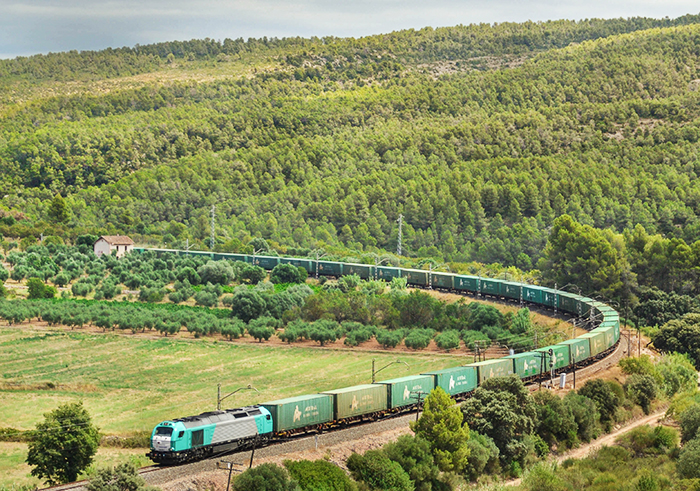
Today, we are Spain’s leading private rail operator offering sustainable door-to-door logistics and freight transport solutions.
With over 80 years of experience in the rail sector, we are a leading company, backed by a reputation for quality and excellence in intermodal freight transport management.
Through our extensive transport network, we offer coverage across the entire Iberian Peninsula, providing a comprehensive solution from origin to destination and optimizing the supply chain through efficient resource management
First service with a 4-axle railcar train of large capacity with 4,500 head of cattle and sheep from Cañaveral to Barcelona. Later on, the company expanded its transport to include parcels and food products, including fruit.
Transfesa revolutionises the market by initiating international rail transport thanks to the use of the first interchangeable axle railcar.
The first axle changing facility is set up in Hendaye.
Transfesa is in charge of the relocation of ‘Las Meninas’ from the Prado Museum in Madrid to the National Gallery in London.
Transfesa inaugurates its new headquarters in Madrid, an intelligent and bioarchitectural building with the most advanced solutions.
First train Yiwu (China)- Madrid. The longest freight train in the world.
Transfesa Logistics celebrates its 75th anniversary, becoming the leader in door-to-door logistics and goods transport solutions.
Transfesa Logistics promotes the CoolRail route together with Euro Pool System, bringing fresh produce from Spain to Northern Europe.
Transfesa begins operating standard-gauge trains between the Iberian Peninsula and the rest of Europe and vice versa, for the first time in its history. On January 3, the first train carrying finished vehicles runs from Perpignan to the Port of Barcelona on UIC gauge.
In December 2025, Transfesa joins the portfolio of intermodal services offered by Boluda Logistics, a subsidiary of Boluda Shipping, thereby integrating its rail services on the Iberian Peninsula.
This integration opens up significant commercial opportunities, not only by increasing our operational capacity but also by diversifying our service portfolio, incorporating new routes, and combining more sustainable modes of transport